Saturday, 7 December 2013

'Tis the Season


Image via DartPhoto Instagram
That's right--it's that time of year again! The 1st of December has passed, which means it is 100% acceptable to blast Wham's "Last Christmas" and break out the Baileys. It also means time for Christmas trees, the fresh scent of pine filling the house and holly berries galore! Winter has graced us with its freezing and windy presence, shops have painted the windows with holiday decorations, and pretty soon we'll all be sat around with our families drinking warm drinks and celebrating the season. Since a REAL Christmas tree is a must (I cannot stress this enough), a little guide on the "where's and how-to's" seemed appropriate to post.


Image via Pinterest
1). Type of Tree: There is no "typical" Christmas tree--and no, they don't all look the same. There are three major families of Christmas trees, which should all be available at your local tree lot. Firs, Spruces, and Pines are the most common, but most people don't know the difference! Firs and Pines have a better needle cling, meaning they won't leave droppings all over your floor or table, while Spruces tend to have much stronger branches (perfect for hanging those heavy ornaments). Make sure to consider all types before taking one home!

2). Where to Buy?: I've always wondered this myself, so it took a bit of research. Being in a major city, there is really no room to set up 50-100 trees and sell them, but there must be somewhere! Pines and Needles and The Christmas Forest seem to be the leaders of the tree selling pack, with a wide variety of trees and multiple locations across the city. For more information, visit them at http://www.pinesandneedles.com and http://www.christmasforest.co.uk. They also do a delivery service…but where is the fun in that? Personally, I like to pick my tree myself. What if it has big holes or something?!

3). No Space? No Problem: Living in a city and wanting a 10' Christmas tree poses a problem…so something to consider with the holiday season approaching is space. I know if I got a Christmas tree in my little Camden flat, I'd have to step over it to get to the bathroom, the kitchen, and the front door. Could I get one of those dinky 3' tall ones? Probably not. If you're like me, the best thing to do is settle for a fresh wreath, swag, or garland! they're all equally as festive, you can still decorate them with ribbons or ornaments, and they smell lovely! If greenery is a completely unviable option, think outside of the box! A pretty dried fruit hanging smells lovely when mixed with cinnamon sticks and cloves, or think of ways to make a tree out of non-traditional things. Below are some examples.


above images via pinterest and instagram 

Gothenburg Botanical Garden: Botaniska Trädgården

     Gothenburg is a city built around nature; the coastal views, the canals which twist their way through city centre, the nature reserve and more, you're never more than a stones throw from some beautiful landscape while still being in central Gothenburg. Lucky for me, I was able to visit Gothenburg in early November, when the weather was still warm (for Sweden anyways…) and winter had yet to knock the beautifully coloured leaves from the trees. I knew Scandinavian countries were famous for their abundance of nature among other things, so I was very happy when I was able to experience this first hand, by visiting Gothenburg's Botanical Gardens and Nature Reserve.


     The Botanical Garden is located just south of what would be considered city centre in Anggården, but easy enough to get to (even for me…on my own…not speaking a lick of Swedish). Entry to the garden grounds is free/20 SEK donation, but the greenhouse costs 20 SEK, a whopping £1.80. The grounds consist of 16 different sections, ranging from 'The Americas Arboretum' to 'Japanese Gardens.' I didn't enter through the main entrance (I couldn't find it) but I made my way there eventually, and started out with a little poke 'round the garden shop, which sells succulent and fern variations, as well as bulbs, pots, cards, and other little trinkets. 


     I willingly paid the 20 SEK to venture into the greenhouse, especially after reading on the leaflet that they had a whole succulent house. Imagine the hearts in my eyes after hearing that! The greenhouse was comprised of about 4,000 plant species in 7 different climates/zones. The entrance to the greenhouse led straight into the "Tropical House," which was the tallest room in the greenhouse, and has everything from moss to palm, coffee and more. It was so warm and humid, I had forgotten about the 4° temperatures outside! From then I discovered the orchid house, which was my second favourite of them all. Seven rooms and 1,600 orchid species is a lot of beauty to take in. 


    I explored the other houses, some of which were being tended to by the garden volunteers, and made my way around to the succulent house, my favourite of the whole bit. Being from California, some of the most beautiful succulent gardens I've seen are in my neighbours yards! I was completely, 100% blown away by the presentation of the succulent house at Botaniska Tradgarden. They divided the succulents by native area, and had the plants beautifully laid out in terra cotta coloured planters. Some of my favourites were native to my area at home, but I discovered a lot of really interesting plants I had never seen or heard of as well.


     After leaving the greenhouses, I made my way through every bit of the garden: the rock garden, the japanese garden, the rhododendron forest, and into the nature reserve. I was amazed by the beauty around me, I may have even welled up a bit (I know, I know). I stayed in the park/garden for about 4.5 hours, which still didn't seem like enough time. I could not believe how they managed to place such a beautiful haven of nature inside a major city; it was beyond me! I am still so envious that we don't have anything the same in London. 

     A few more photos from my walk around:


Tuesday, 26 November 2013

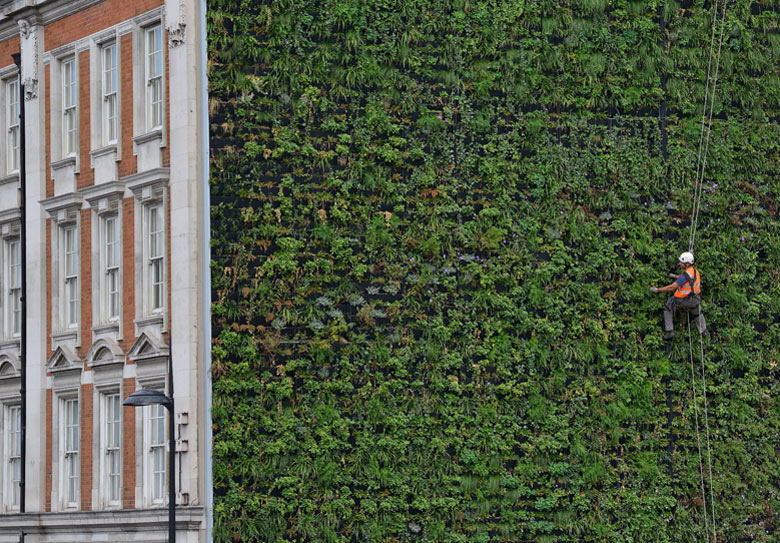
London's Largest Living Wall


     The Rubens at The Palace Hotel in Victoria, London, is now home to the city's largest living wall. The vertical garden stands 21 metres tall and is home to over 10, 000 plants, including 20 seasonal varieties. The aim of the 350 square metre natural surface is to reduce air pollution and help control urban flooding, by holding water in large storage tanks.

     Older parts of London tend to have poor irrigation systems, which are crucial in such a wet environment. The Victoria Business Improvement District brought in Cary Grant of Green Roof Consultancy to design the permanent feature. The wall will water itself through a drip irrigation system--water from the large tanks will trickle down through the wall to feed the plants, promoting a sustainable irrigation system. The storage tanks can hold up to 10,000 litres of water, which will nearly eliminate all flooding on Victoria's old, cobbled roads.


    The plants used to create the living masterpiece were selected very carefully. The Royal Horticulture Society approved, saying that the plants chosen are sure to attract a wide variety of pollinators, including birds, bees, and butterflies. There are high hopes for the success of pollinators, with the bee decline over recent months being it's largest ever. The hotel's website states "We take the issue of sustainable tourism very seriously [] this wall will minimise the hotel’s impact on the environment but also improve the air quality and aesthetic in this part of London." 

    The Rubens at The Palace's new addition is one of many green surfaces popping up around London. Victoria BID are hoping this will promote sustainable ecosystems in urban environments, as well as be visually appealing for tourists and locals alike. 

     Below is a time lapse video of the wall being built:

Wednesday, 16 October 2013

Exhibition//Black and White, In Colour

A new exhibition opens at Shirley Sherwood Gallery of Botanical Art in Kew, London on Saturday. The exhibition, which will be open until 5 January 2014, explores the importance of black and white in the plant world. The paintings in the exhibition will be provided by Sue Wickison and Sue J. Williams. They explore the subtleties of both colours in plant life.  
Arisarum, Sue Wickison

The theme of the exhibition is contrast and opposites--apparent in the title and the content. It's aim is to show the possibility of combinations in an obviously restricted spectrum of colours, and how these creations translate in their artwork. The subject matter covers a large range of species, and includes plants both familiar and exotic. The exhibition is free with entry to Kew Gardens (tickets £14.50/adult and £12.50/concession). For more information, cal0208 332 3622 or visit shirleysherwoodgallery@kew.org. 

Kew Hellebore, Sue J. Williams


Houseplants //

Houseplants are a great way to liven up a living space, and can often be used in place of artwork or decorations. They're colourful, can be placed just about anywhere, and can really spruce up an area (especially when the weather is as dull as it has been!). Aside from a bit of water or plant food every now and again, they are very low maintenance. Since nature has been linked to stress reduction, and it's a well known fact that plants create oxygen (super fresh air, anyone?) here are some house plants to consider next time you find yourself wandering around the garden centre, or even your nearest Homebase

1.) English Ivy: Studies have shown that Ivy is among the best plants for air filtering, and can even reduce the amount of formaldehyde fumes left from cleaning products. It's pretty difficult to kill off, but to keep it happy, plant in a hanging basket, keep it moist, and you're good!

2.) Spathiphyllum/Peace Lily: One of the easiest (and debatably most beautiful) houseplants to care for is the peace lily. Its white flowers are a beautiful contrast to its dark green leaves, and they require very little upkeep. Put them in some indirect sunlight, keep the soil damp, and mist the leaves with a spray bottle to recreate humid, Southeast Asian climate and your plant will thrive.

3.) Snake Plant: This standing plants variegated leaves make a beautiful addition to the corner of any room, as they grow upwards, not out. Indoors, it can survive in cooler climates with indirect/little sunlight, and converts carbon dioxide to oxygen in the night, unlike most plants. It holds cultural significance in African rituals, and makes for a beautiful ornamental addition to a room. 

4.) Philodendron: The leaves of the philodendron remind me of little hearts, which is probably why this is one of my favourite house plants. That, and they live for ages. With some moderate watering and mild sunlight (ie-anywhere) these little guys will grow the sweetest little vines, and filter out formaldehyde in the process. They're pretty vigorous growers, so no need to worry about being the most plant savvy of the bunch. They're pretty hardy!

5.) Spider Plant: Spider plants get their name from the little clumps of leaves, or plantlets, that grow from their dangling stems. They're in the top 5 houseplants because they can make it pretty much anywhere, even without natural light. The spider plant does fine on bright, artificial light, and only needs watering when the soil feels dry. They can survive in temperatures as low as 4.5C (though let's hope nobody's house is that cold this winter!) and are pretty interesting to look at. Their variegated leaves are long and thin, and pretty cute if you ask me.


And there you have it! Five pretty simple (and easy on the eyes) houseplants that anyone can own, regardless of gardening skill!


Intro //

Hello~!

This blog will primarily discuss nature in an urban environment, i.e.-living walls, incorporating greenery into one's living space, and so on. It will also feature events around the city, organisations such as the Royal Horticulture Society, and mention what's on at remarkable establishments such as Kew Gardens.

Enjoy! x